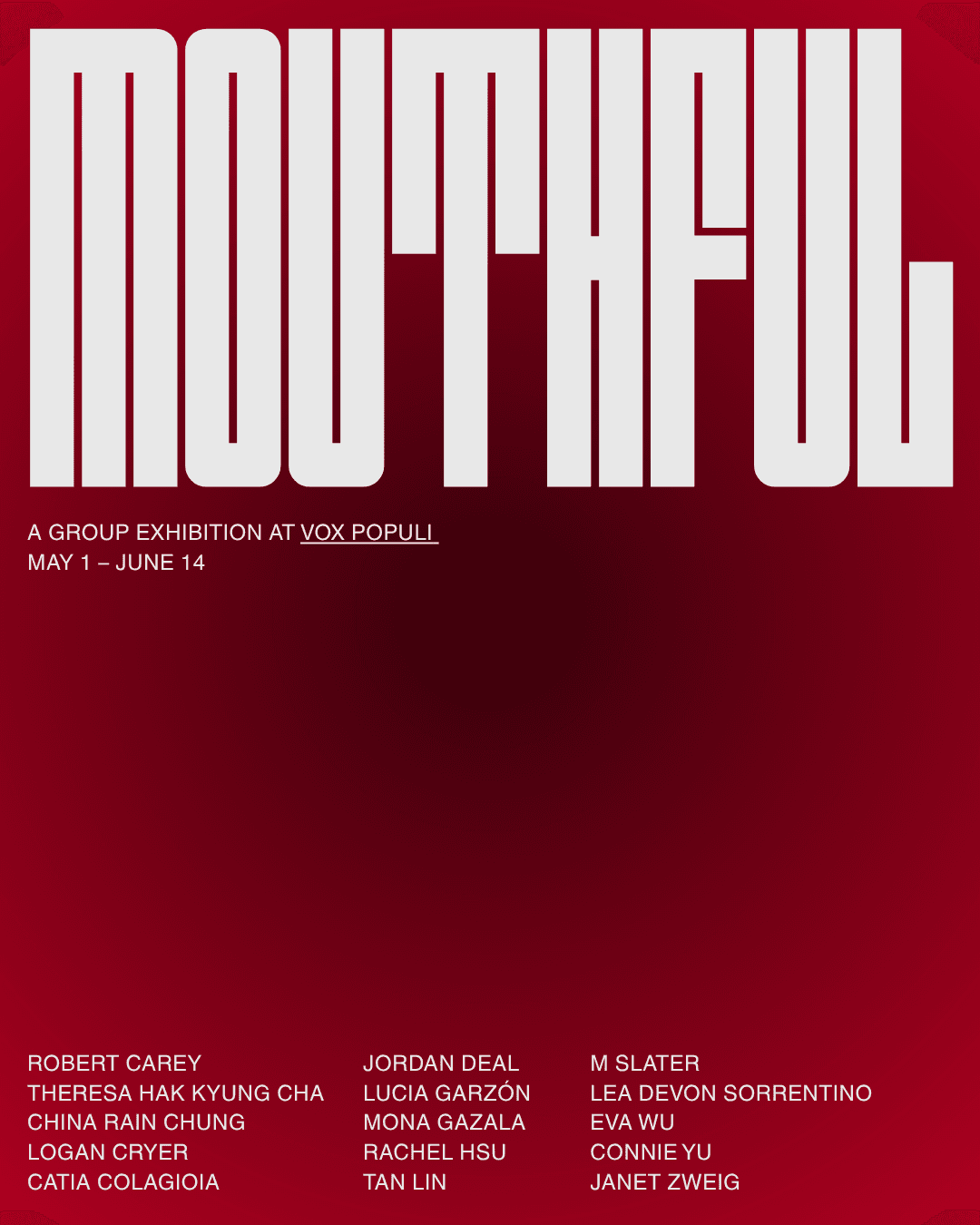
MOUTHFUL
Robert David Carey is a dynamic contemporary artist whose practice spans mixed media, installation, video, performance, and printmaking, rooted in an exploratory ethos that bridges personal narrative with broader cultural dialogues. Based in the vibrant arts scene of Philadelphia, where he maintains a studio amid the city's thriving community of experimental creators, Carey draws from a multidisciplinary background that echoes influences from comic book illustration and graphic storytelling, evident in his layered compositions and narrative-driven works. His style fuses raw materiality with digital ephemerality, often employing found objects, projected imagery, and performative elements to interrogate core themes of identity, consumption, and the body's unspoken hungers. Working across scales—from intimate prints that whisper secrets to immersive installations that demand physical engagement—Carey's art reflects a restless curiosity about how everyday excess shapes human experience, transforming galleries into sites of visceral confrontation. What distinguishes Carey's oeuvre is its distinctive visual language: a chaotic yet deliberate alchemy of textures and media that evokes the surreal mechanics of desire, reminiscent of Dadaist assemblages filtered through modern digital glitches and performance art's immediacy. Influences from Irish graphic novel traditions and sci-fi comics infuse his pieces with a speculative edge, where cultural contexts of urban alienation and bodily politics collide—think fragmented prints that mimic comic panels unraveling into three-dimensional chaos, or video loops capturing performers grappling with edible metaphors. In specific works, he might deploy oversized printmaking presses to extrude metaphors of ingestion, blending the tactile grit of ink and pulp with performative acts that blur artist and audience, challenging viewers to confront the indigestible undercurrents of contemporary life. This fusion creates a signature tension, where humor undercuts horror, and the mundane morphs into the profound. In the group exhibition "MOUTHFUL" at Vox Populi Gallery, curated by Blanche Brown, Philly audiences will encounter Carey's contributions as electrifying punctuations within a chorus of bold explorations into appetite and articulation. His installations and performances promise to activate the space with sensory overload—perhaps video projections of mouths in perpetual motion synced to live printmaking rituals, inviting visitors to navigate a labyrinth of overflowing forms that mirror the exhibition's theme of insatiable expression. For local viewers steeped in Philadelphia's punk-inflected art ecosystem, Carey's presence underscores the city's role as a hub for boundary-pushing intermedia, offering an unforgettable immersion that lingers like a half-swallowed revelation, cementing his voice as essential to this collective feast.
All exhibitions →Theresa Hak Kyung Cha was a groundbreaking multidisciplinary artist born in Busan, South Korea in 1951 who immigrated to Hawaii at age eleven before settling in San Francisco two years later. Though she lived only thirty-one years, dying in 1982, Cha produced an astonishingly diverse body of work that resisted easy categorization, working across ceramic, performance, artist's books, concrete poetry, film, video, sculpture, mail art, audio, and slide projections. Her practice was deeply rooted in language itself—Korean, English, and French flowed through her work as material rather than mere communication. In her own words, she sought "the roots of the language before it is born on the tip of the tongue," and she developed what she called "multiple telling with multiple offering," a method of combining images, text, and sound to give audiences multiple entry points into her work. This philosophy of multiplicity defined everything she created, whether she was marking invisible wax letters on paper that would only reveal themselves when held over a candle, or layering fragmentary images, text, and sound across installations that explored memory, displacement, and perception. What distinguished Cha's work was her understanding of language, perception, and the body as inextricably linked materials for artistic investigation. Her performances were conceived as immersive spectatorial experiences where viewers became active participants rather than passive observers, a philosophy evident in pieces like "Reveille Dans la Brume," presented in San Francisco in 1979. The ritualism in works such as "A Ble Wail" drew on Korean shamanic traditions, while her repeated interrogation of Korean vowels in "Mouth to Mouth" transformed linguistic meaning itself into something fractured and ephemeral. Her video and multimedia installations like "Exilée," created following her 1979 return to Korea, measured distance and displacement not merely as geography but as psychological and temporal experience, exploring the sixteen time zones that separated her from her country of birth. Throughout her career, she employed techniques of interruption, fragmentation, and visual complexity that mirrored her lived experience of migration and the "imprint, the inscription etched" that displacement leaves on identity. For audiences at "MOUTHFUL," Cha's presence offers a profound meditation on how voice, language, and the body communicate across cultural boundaries and generational distances. Her work invites viewers to experience how meaning fractures and reforms, how displacement shapes perception, and how the act of speaking itself—whether through text, sound, or movement—becomes a site of both connection and alienation. In an exhibition concerned with utterance and expression, Cha's mixed media and video installations serve as a vital precursor to contemporary conversations about multilingual identity, embodied knowledge, and the limits of language to contain experience. Her insistence that art could exist in the liminal spaces between genres and mediums, combining performance with visual material, sound with text, anticipates the hybrid approaches that define contemporary artistic practice and offer Philadelphia audiences a transformative encounter with an artist whose influence continues to resonate far beyond her tragically brief career.
All exhibitions →Janet Zweig is a Brooklyn-based artist renowned for her work in the public realm, where she crafts interactive sculptures, installations, and commissions that blend mechanical ingenuity with linguistic play. Her practice spans mixed media, including computers, printers, and analog components that generate text and sequences in real time, echoing her earlier editioned artist’s books from the 1970s and 1980s, such as Sheherezade. Zweig’s style fuses the digital and tactile, often orienting viewers toward environmental awareness or communal narrative—evident in commissions like a departure gate to fictional locales at Austin Airport, a tidal river guide in West Sacramento, and a climate-tracking mechanism at a San Diego library. Her core themes revolve around language as a dynamic material, exploring sequence, generation, and public interaction, with exhibitions at prestigious venues like the Brooklyn Museum of Art, PS1, and the Walker Art Center. Teaching at the Rhode Island School of Design and Brown University, she continues to influence emerging makers through residencies and awards, including the Rome Prize and NEA fellowships. What distinguishes Zweig’s oeuvre is its generative visual language, where machines produce evolving sentences or phrases, bridging personal expression with collective input, as in a growing wall text in Columbus penned by residents or an interactive light rail project in Minneapolis incorporating hundreds of voices. Influenced by conceptual art’s interrogation of systems, her work resonates in a cultural context of data-driven publics and climate urgency, prefiguring contemporary digital poetics while rooting in mechanical whimsy. Pieces like the 1995 Thinking Contest exemplify this, pitting language against itself in playful contests that reveal the absurdities of communication. Her public interventions, such as the 1200-foot frieze in New York’s Prince Street subway, transform urban spaces into sites of unexpected dialogue, drawing from literary traditions and technological hybridity to challenge passive spectatorship. In Vox Populi’s MOUTHFUL, curated by Blanche Brown, Philly audiences will encounter Zweig’s Thinking Contest amid a chorus of language-centric works, from archival gems to fresh provocations like flags and concrete slabs. This group exhibition, running through June 2026, positions her 1995 piece as a historical anchor, inviting visitors to grapple with how artists wield words as material—through, against, or alongside it. Zweig’s kinetic text generator will pulse with the show’s dissonant rhymes across five decades, offering a tactile encounter with mechanical wit that underscores language’s slippery agency, perfectly attuned to Philadelphia’s vibrant, inquisitive art scene.
All exhibitions →MOUTHFUL, curated by Vox Populi's director Blanche Brown, gathers over fifteen artists to probe the slippery contours of language as both material and medium, weaving through, against, and alongside its forms to unearth persistent questions about communication's fractures and…